
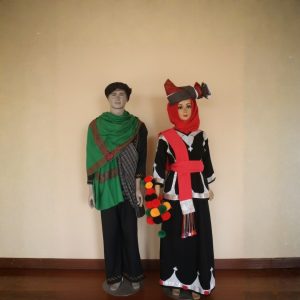
 The traditional attire of Padang Magek Batusangkar, from Tanah Datar Regency, West Sumatra, stands as a living symbol of Minangkabau grace and philosophy. It beautifully balances tradition and elegance, reflecting harmony between masculinity and femininity, modesty and pride.
Men’s attire consists of a plain black shirt with long sleeves, symbolizing the simplicity and steadfastness of a Minangkabau man. On their heads, men wear a black deta, a traditional Minangkabau head covering wrapped around a triangle. This deta symbolizes the wisdom, honor, and status of a man who has matured in thought and action. Over their shoulders, a green shawl with gold embroidery, called a salempang, symbolizes coolness, fertility, and peace of mind. The inner layer is a gray checkered sarong, a symbol of hard work and responsibility. Loose-fitting black trousers, or galembong, create an elegant yet mobile impression, reflecting the Minangkabau philosophy of alam takambang jadi guru ‘nature is the greatest teacher’—life must be flexible, adaptable, but still principled. “nature is the greatest teacher.”
The women’s costume radiates elegance through its black blouse adorned with silver and white embroidery, exuding both grace and nobility. On the head, the woman wears a distinctive headdress (tengkuluk) made from gray and red fabric, artfully wrapped like a crown, symbolizing the Minangkabau woman’s wisdom and high status as guardian of family honor. Underneath the tengkuluk, she wears a bright red veil, embodying courage, love, and vitality — the inner fire that inspires her life. A red sash drapes diagonally from shoulder to waist, balanced by a red belt that signifies inner strength and discipline.
The hem of the skirt is decorated with white embroidered arcs and stars, symbolizing noble aspirations and purity of heart. In her hand, she holds a colorful string of pom-poms — red, green, yellow, and black — expressing joy, diversity, and unity.
The Padang Magek traditional attire is more than clothing; it is a poetic embodiment of Minangkabau values — “Adat basandi syarak, syarak basandi Kitabullah” — where each color, fabric, and ornament conveys moral lessons passed down through generations.