
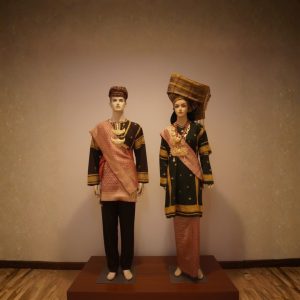
The traditional costume of Sungayang, from Tanah Datar Regency, West Sumatra, stands as a majestic representation of Minangkabau heritage — rich in symbolism, elegance, and philosophy. This attire is worn during prestigious traditional ceremonies and weddings, reflecting dignity, nobility, and cultural pride.
The men’s outfit consists of a dark brown or black long-sleeved shirt decorated with golden embroidery along the cuffs and neckline, symbolizing strength and honor.
On the head, he wears a traditional headcloth called “deta” or “destar”, made from golden-brown songket fabric, neatly folded in a triangular form resembling a crown — a mark of wisdom and leadership. A pink-golden songket shawl (salempang) is draped across the shoulder, representing grace and prestige. Across his chest, he wears a three-tiered crescent-shaped gold necklace, known as kalung bulan, signifying the harmony of religion, tradition, and knowledge — the three pillars of Minangkabau life. The attire is completed with loose black trousers (galembong), symbolizing modesty and freedom of movement.
The women’s costume radiates regal elegance. She wears a dark green long tunic richly embroidered with gold threads, symbolizing fertility, calmness, and prosperity.
Her head is adorned with a grand tengkuluk balapak, a magnificent golden-brown songket headdress shaped like buffalo horns, symbolizing the pride and wisdom of Minangkabau women as bundo kanduang, the matriarchal guardian of tradition.
Around her neck hangs a layered gold necklace, representing wealth and dignity, while a pink-golden songket shawl drapes diagonally across her chest, balancing strength and elegance. The lower part of her outfit consists of a matching pink-golden songket sarong with fine geometric patterns that reflect patience and precision.
The Sungayang traditional costume is not merely a dress — it is a living philosophy of Minangkabau identity, reflecting the maxim “Adat basandi syarak, syarak basandi Kitabullah” — customs founded upon faith, and faith guided by divine wisdom.