
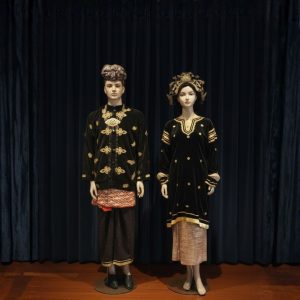
This photograph showcases a refined pair of traditional garments from Solok Regency, West Sumatra, featuring elegant black velvet adorned with golden embroidery. In Minangkabau symbolism, black represents maturity, wisdom, and dignity, while gold emphasizes honor, prosperity, and noble values.
On the left stands the groom, wearing a black embroidered headcloth with sharp folds, reflecting the firmness and decisiveness expected of Solok men. His upper body is dressed in a black straight-cut jacket decorated with symmetrical gold floral motifs that convey simplicity with authority. A traditional round gold necklace rests on his chest, signifying his role as a family protector. Wrapped around his waist is a copper-toned songket cloth, symbolizing his responsibility to preserve family honor. His modest black shoes quietly remind us that greatness lies not in opulence, but in dignified conduct.
To the right, the bride appears graceful in a black velvet long-sleeved tunic edged with golden trimming around the neckline, sleeves, and hem, highlighting the dignity of Solok women. Her head is crowned with a small black-and-gold suntiang, unlike the tall headdresses of coastal areas, emphasizing modesty and restraint—traits associated with women of the highlands who guard matrilineal lineage.
She wears a soft shimmering pink songket skirt, falling straight to the ankles to preserve refinement and modesty. Completing the attire are silver slip-on shoes, symbolizing steps guided by tradition and honorable upbringing.
Together, these garments embody Solok’s cultural philosophy: Black for dignified tradition, gold for noble character, and songket for heritage. A quiet yet profound beauty, this attire invites travelers to experience Solok’s cultural richness, where elegance is not loud, but deeply meaningful.