
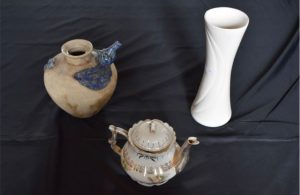
Three ceramic objects with distinct historical backgrounds and styles are presented together. The first, on the left side, is a Glazed Ceramic Jug (Kendi) that radiates an ancient and local aura. It has a globular, bulbous body tapering to a short neck, complete with a small spout. The body’s surface is rough, a pale, dull light brown color, and features only an uneven patch of dark blue glaze on the shoulder and spout. A jug with these characteristics of imperfect glazing and clay body is highly likely to be local Southeast Asian earthenware, and based on ancient maritime trade patterns, is likely associated with a major island like Sumatera.
The second piece, in the lower center, is a much more elegant Metal-Mounted Porcelain Teapot. This teapot is made of fine white porcelain, rounded in shape with a scalloped-edge domed lid. The body is decorated with delicate, colorful floral motifs (pink and green). The most distinguishing feature is the gleaming metallic coating—likely silver or silver-plate—that encases the lower section and the rim of the lid. The decorative style combining imported porcelain with metal mounts is purely European (Victorian period/19th century).
Finally, on the right side, stands a sleek Contemporary Design Ceramic Vase. This vase offers a contrast due to its slender geometric simplicity. It is tall, slim, and hourglass-shaped, with a smooth, pure white surface. The vase features spiraling vertical grooves around the body, lending a dynamic texture. This vase reflects a Contemporary design aesthetic (post-1950s) and is typically manufactured by modern producers in Europe, North America, or East Asia.