
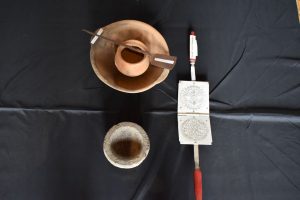
This collection showcases three types of traditional tools closely associated with the processes of food preparation and pastry making in the kitchen, reflecting the culinary traditions of Indonesian culture.
The first part features Pounding or Grinding Tools (lower left), represented by a Stone Mortar (Lumpang Batu) or small pestle made from natural stone. It has a rounded shape with a central hollow used for crushing ingredients such as spices. The stone surface appears rough and is brownish-grey in color. Although such tools are used globally, in Indonesia the stone mortar plays a central role in spice preparation and is common throughout Java, Sumatra, and nearly all regions of the archipelago.
The second part is Container and Stirring Tools (upper center), consisting of two containers and one stirrer or spatula. The largest item is a Wide Wooden Bowl, light brown in color, used for mixing dough or holding ingredients. On top of it rests a small Clay Pot or Ewer (Gerabah), reddish-orange in tone, used for storage or small-scale cooking. Above them lies a Spatula or Stirrer made of metal or wood with a faded paper label. Such earthenware and wooden implements are characteristic of traditional kitchens across Indonesia, reflecting the use of locally sourced natural materials.
The third component is the Snap or Waffle Cookie Mold (right), the most distinctive piece in the collection. It consists of two hinged iron or aluminum plates with long handles. The mold’s interior is engraved with highly detailed, symmetrical geometric motifs featuring floral (rosette) and vine patterns that imprint designs onto the dough. The handles are insulated in red and white. In Indonesia, this tool is known as the Kue Semprong Mold, Kue Gapit Mold, or Traditional Waffle Mold and is essential for making thin, crispy cookies. Such elaborately engraved molds are deeply associated with the traditional cookie-making practices of Java and Sumatra, influenced by both Dutch and Chinese culinary cultures.