
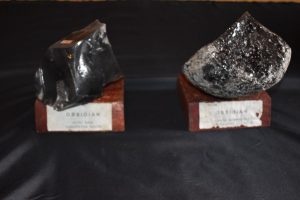
This collection showcases two specimens of Obsidian, a volcanic igneous rock formed from the rapid cooling of lava, resulting in a distinctive glassy texture without visible mineral crystals. Both specimens are displayed on reddish-brown wooden bases used for presentation.
The first specimen (left) is a piece of obsidian with a mostly smooth and glossy surface, reflecting light like glass. The second specimen (right) is also obsidian but has a rougher and slightly duller surface, with some areas showing a glassy sheen and others appearing more matte.
Both specimens originate from Solok Regency, West Sumatra, with one specifically found in the Koto Bani area. Solok is a region rich in volcanic activity, making the presence of obsidian—a product of volcanic eruptions—common and geologically significant. Obsidian holds historical value as it was widely used by prehistoric societies to craft sharp tools.